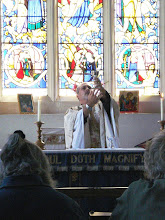
Two vicars got married in their local parish church. This isn't a joke.
Nor is it unusual. After all, General Synod authorised the ordination of women as priests way back in 1992, many moons ago - at least by Post-Modern Reckoning, or
PMR. What is unusual about the recent case is that both the bride and groom are -
erm - men.
This has not gone
unnoticed.
- Pessimists call it further evidence of the secularisation of British society.
- Realists call it compulsory compliance with civil rights legislation.
- Optimists call it not just a blessing of a couple of guys in smart dress, but a blessing in disguise for a Church that's in distress.
True enough, the call for same-sex blessings is anything but business as usual for the Church of England. But one thing the Church - itself a rather successful '
startup company' founded by the ever-entrepreneurial realist King Henry VIII - isn't doing is burying her head in the sand, at least her head for business.
And business is exactly what the Established Church must be about these days.
Learned dialogue isn't called for here. Anglicanism has always played a more political than theological game when deciding Matters of Great Importance. That is its genius. Anglicanism is professedly non-confessional and veritably non-
creedal - not even the existence of God, let alone the doctrine of the
Trinity, are
enforcible dogmas. In actual fact, Anglicanism - and empirical facts are what matter most to most Anglicans - quite uniquely amongst all Churches and
ecclesial communities, has never concocted anything resembling an original theology.
Walter Cardinal Kasper,
President of the Pontifical Council for Promoting Christian Unity, also has observed the Church of England's exquisitely political
métier. He commented on General Synod's recent move toward the consecration of women to the episcopate, considered by most English Anglicans (i.e., those whose parents had them 'done') to be merely a matter of civil rights, and thus long overdue.
Earlier this year, on the day that Dr [Rowan] Williams met the Pope, Cardinal Kasper told a meeting in Oxford, that Anglicans needed to “clarify” their identity. He said: “Ultimately, it is a question of the identity of the Anglican Church. Where does it belong? Does it belong more to the churches of the first millennium -Catholic and Orthodox - or does it belong more to the Protestant churches of the 16th century? At the moment it is somewhere in between, but it must clarify its identity now and that will not be possible without certain difficult decisions."
Times Online, 16 July 2008
Which simply proves the point really. Cardinal Kasper just doesn't get it. If Theology and Canon Law
may be said to define the universal Church of Rome, Civility and Common Law
define the national Church of England. Put in sociological terms, the Church of England is a
'civil religion'.
But labels are always ancilliary, beside the point - especially when there isn't one (theologically)!
Now here's the rub. Civil partnerships are now gender-blind in the Common Law statutes of England. It is patently inevitable, even juridical, that the Common Worship rites of England will soon follow suit.
But will its inevitable affirmation of gender-neutral marriage bode well for a Church beset by deficits? After all, there is a shortage of available clergy, and money to pay them if there weren't.
In a word: infertility.
Childlessness is utterly unnatural for those who opt for opposite-sex marriage, especially those who opt to procreate. Abortion-on-demand makes infertility even more difficult since so few babies are available for adoption. Yet few can argue against the justice and logic of natural selection, and fewer still on its behalf.
Alternatively, contrary to the
Catechism of the Catholic Church (cf.
CCC 2357), gay and lesbian unions are normal, and childless ones are happily natural. (Anglicanism is of course as non-
catechetical as it is non-confessional and non-
creedal.) Indeed a gay or lesbian couple might opt to adopt, which is meet and right so to do, arguably
moreso than childless different-sex married couples who've been wounded psychologically by chronic infertility.
I call it the '
broodless breeders syndrome'. That's my prerogative because I have experience here. And experience makes it meet and right so to do.
But childless same-sex couples have fewer professional (children) and psychological (infertility) impediments and are thus eminently attractive to employers but especially an understaffed and underfunded Church. Though clergy in the Church of England are allowed to have a family, based on its sole moral criterion of
civility, they are forbidden ever to let family events interfere with parish events.
After all, in these times of decreasing clergy and coffers to pay them, the last thing needful parishioners need is their 'breeding' vicar to insist his daughter's first piano recital is more important than attending the Mothers' Union
AGM.
And God knows that civil statutes like the
UK's Working Time Regulations have no place in parish priesthood.
Ask any married vicar with children, and he or she will tell you. Church and children are more often than not an untidy and very unhappy mix.
And what sort of priest is least likely ever to use children to justify not working weekends and fourteen hour days? Gay and lesbian ones of course! And especially those married with the Church's blessing upon their naturally non-procreative intentions.
Of course none of you who is an Anglican at heart would notice any contradiction in my argument.
 Shame on Britain for emulating the US and its turbo-Capitalism:


 Posts